
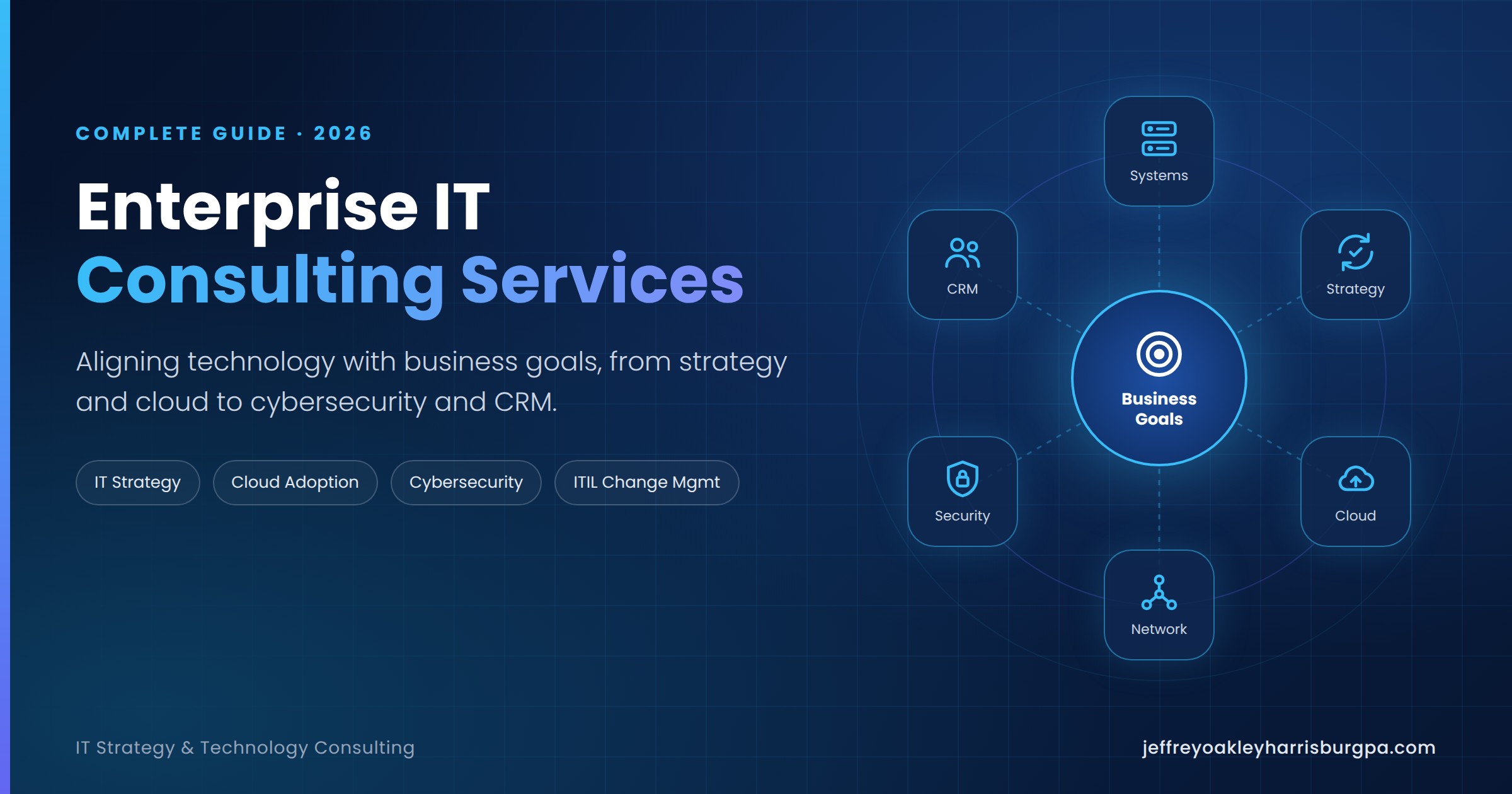
Quick Answer: Enterprise IT consulting helps organizations plan, build, secure, and improve their technology so it supports business goals. The work usually covers six areas: IT systems design, digital transformation strategy, cloud adoption, network infrastructure, cybersecurity, and CRM or enterprise software. A good consultant starts with what the business needs and then picks the technology to deliver it.
Many organizations adopt technology in pieces. A new tool gets added here, and a server upgrade happens there. Over time, the environment gets complicated, expensive, and hard to secure. Enterprise IT consulting brings order to that growth by giving every technology decision a clear business reason.
At Jeffrey Oakley, Harrisburg, PA, the guiding principle is that technology should serve the business, not the other way around. This guide explains each core service, how the services work together, and how to tell when your organization would benefit from outside IT expertise.
Key Takeaways
- IT strategy should come before choosing tools, so every investment supports a measurable goal.
- The six core services, systems design, digital transformation, cloud, networking, cybersecurity, and CRM, work best together, not one at a time.
- Structured change management, based on ITIL practices, reduces downtime and risk during upgrades.
- Security should be built into every layer from the start, not added at the end.
- Common signs you need IT consulting include rising costs, frequent outages, disconnected systems, and a lack of clear technology direction.
What Is Enterprise IT Consulting?
Enterprise IT consulting is a professional service that reviews an organization’s technology, finds gaps and risks, and designs a plan to improve performance, security, and scalability. It goes beyond fixing individual problems. It looks at how systems, networks, data, and people connect across the whole organization.
A consultant acts as a strategic partner. The job is to translate business goals such as growth, efficiency, compliance, or better customer service into concrete technology decisions and then support how those decisions are carried out.
The Core IT Consulting Services Explained
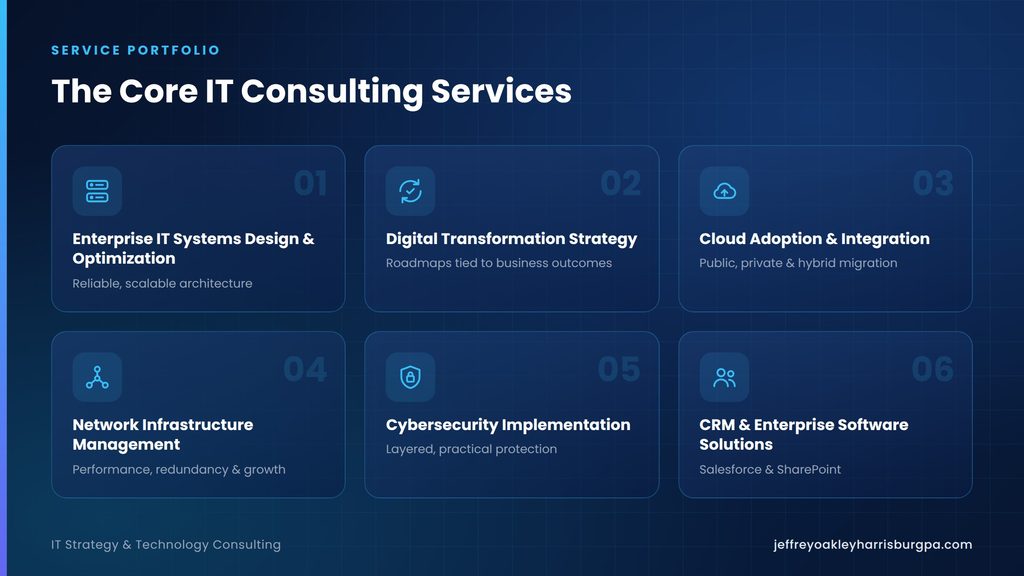
The service portfolio at Jeffrey Oakley, Harrisburg, PA, covers six connected areas. Each one addresses a different part of how an organization runs.
1. Enterprise IT Systems Design & Optimization
What it is: Planning, building, and improving the core systems an organization depends on every day, including servers, applications, databases, and the integrations between them.
What it includes:
- Assessing current systems for performance problems, bottlenecks, and outdated parts
- Designing system architecture that can grow as the organization grows
- Consolidating repeated or overlapping systems to reduce cost and complexity
- Performance tuning and capacity planning
- Documentation and standards for long-term maintenance
Why it matters: Well-designed systems stay reliable as demand grows. Optimizing existing infrastructure often improves performance without the cost of replacing everything.
2. Digital Transformation Strategy
What it is: A structured plan for updating how an organization operates using technology, tied directly to measurable business results.
What it includes:
- Reviewing current business processes and technology maturity
- Identifying which manual or outdated workflows to automate or update first
- Building a phased technology roadmap with clear priorities
- Aligning stakeholders and leadership around shared goals
- Defining success metrics for each phase
Why it matters: Transformation fails when it is driven by trends instead of goals. A clear strategy keeps investments focused and makes progress measurable.
3. Cloud Adoption & Integration
What it is: Moving workloads, applications, and data to cloud platforms and connecting cloud services with the systems that stay on-premises.
What it includes:
- Cloud readiness assessments and workload analysis
- Choosing the right model: public, private, or hybrid cloud
- Planning and carrying out migrations with minimal disruption
- Integrating cloud services with existing on-premises systems
- Managing ongoing cloud costs and governance
Why it matters: The cloud offers flexibility and scalability, but a poorly planned migration can raise costs and create security gaps. A structured approach delivers the benefits without the surprises.
4. Network Infrastructure Management
What it is: Designing, maintaining, and improving the networks that connect people, devices, and systems across an organization.
What it includes:
- Network design for performance, redundancy, and growth
- Setting up and managing routers, switches, firewalls, and wireless networks
- Monitoring network health and fixing connection problems
- Segmenting networks to improve both performance and security
- Planning upgrades before capacity runs out
Why it matters: The network carries every application, transaction, and communication. When it is slow or unstable, the whole organization feels it.
5. Cybersecurity Implementation
What it is: Putting practical security controls in place that protect data, systems, and users from threats that keep changing.
What it includes:
- Security risk assessments and vulnerability reviews
- Access control, identity management, and multi-factor authentication
- Endpoint protection and patch management
- Security policies and user awareness guidance
- Incident response planning and recovery readiness
Why it matters: Cybersecurity is a business risk, not only an IT issue. Practical, layered controls reduce exposure while keeping systems easy to use.
6. CRM & Enterprise Software Solutions
What it is: Implementing, configuring, and improving business platforms such as Salesforce and SharePoint so teams can manage customers, content, and collaboration effectively.
What it includes:
- Choosing platforms and planning how they will be implemented
- Customizing workflows to match real business processes
- Data migration and cleanup
- Integrating CRM and collaboration tools with other systems
- User adoption support and ongoing improvement
Why it matters: Enterprise software only delivers value when people use it well. Proper configuration and integration turn these platforms into tools that raise productivity instead of adding friction.
How the Services Work Together
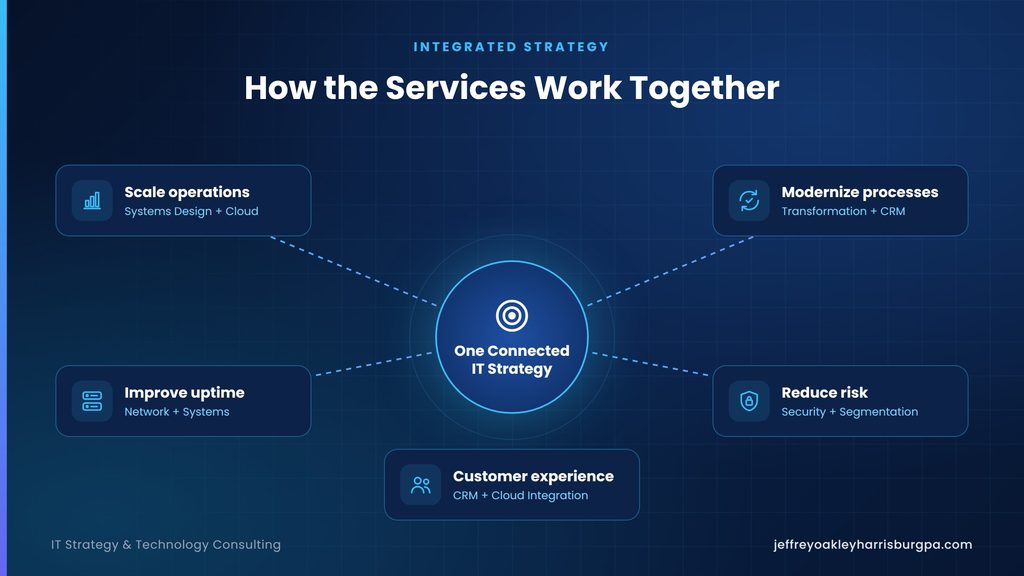
No service works alone. The strongest results come when they are planned as one connected strategy.
| Business Goal | Services Involved | Expected Outcome |
| Scale operations efficiently | Systems Design, Cloud Adoption | Infrastructure that grows with demand |
| Modernize legacy processes. | Digital Transformation, CRM Solutions | Faster, automated workflows |
| Improve reliability and uptime | Network Management, Systems Optimization | Fewer outages and slowdowns |
| Reduce security risk | Cybersecurity, Network Segmentation | Stronger protection for data and systems |
| Improve customer relationships. | CRM Solutions, Cloud Integration | Unified customer data and better service |
For example, a cloud migration affects network design, security policies, and software integrations. Planning all of these together avoids costly rework later.
The Consulting Approach: From Assessment to Optimization
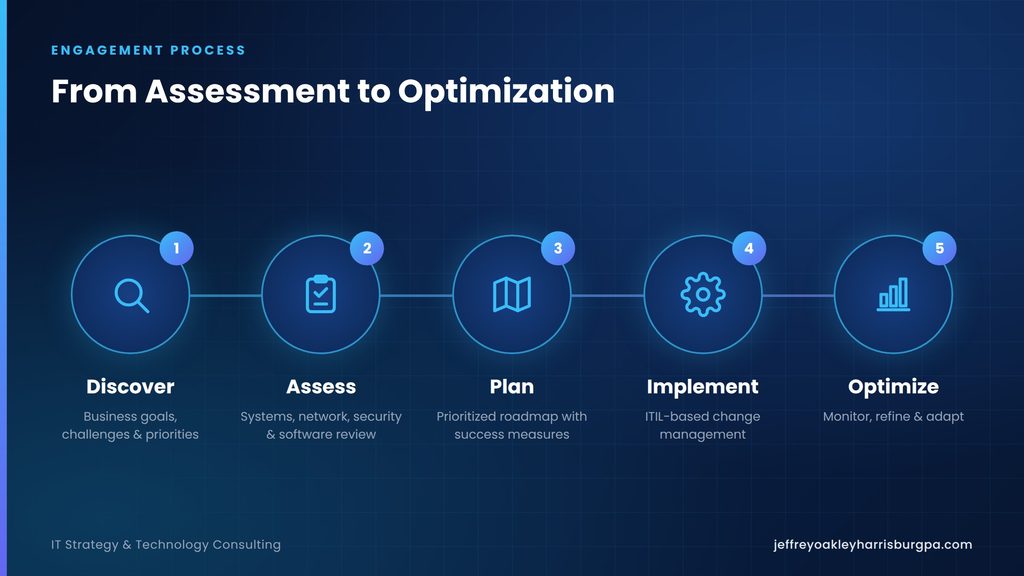
A disciplined process reduces risk and keeps projects on track. A typical engagement follows five stages:
1. Discover: Understand business goals, challenges, and priorities.
2. Assess: Review current systems, networks, security posture, and software.
3. Plan: Build a prioritized roadmap with clear timelines and success measures.
4. Implement: Carry out changes using structured, ITIL-based change management to reduce disruption.
5. Optimize: Monitor results, refine performance, and adjust as needs change.
ITIL, or Information Technology Infrastructure Library, is a widely used framework for managing IT services. It ensures changes are planned, tested, approved, and documented before they reach live systems, which lowers the chance of unexpected downtime.
Experience That Shapes the Approach
Enterprise technology rewards hands-on experience. The approach at Jeffrey Oakley, Harrisburg, PA, draws on more than 15 years of practical IT work. That includes systems administration with the Pennsylvania Army National Guard and work supporting the Defense Information Systems Agency and the Defense Logistics Agency.
Government and defense environments require strict reliability, security, and change-control standards. Those same standards carry over to private-sector and commercial organizations that need dependable, well-governed technology.
Signs Your Organization Needs IT Consulting
Consider bringing in an IT consultant if any of these sound familiar:
- Technology costs keep rising without clear improvements in performance
- Frequent outages, slow systems, or network problems disrupt daily work
- Systems don’t communicate, so teams rely on manual workarounds
- There is no documented technology roadmap or long-term plan
- A cloud migration or major software rollout is planned but not yet scoped
- Security concerns are growing, or compliance requirements are becoming harder to meet
- CRM or collaboration platforms are underused or poorly configured
Frequently Asked Questions
What does an IT consultant do for a business?
An IT consultant reviews an organization’s technology, identifies risks and inefficiencies, and creates a strategy to improve systems, security, and performance. The consultant often guides implementation as well, so changes are made correctly and with minimal disruption.
What is the difference between IT consulting and managed IT services?
IT consulting focuses on strategy, planning, and specific improvement projects. Managed IT services focus on ongoing day-to-day support and monitoring. Many organizations use consulting to set direction and improve their environment, then keep it running with internal teams or managed services.
How long does a cloud migration take?
It depends on the number of workloads, how complex the data is, and integration requirements. Small migrations may take a few weeks, while enterprise migrations are usually phased over several months to reduce risk.
Why is digital transformation strategy important?
Without a strategy, technology investments tend to be disconnected and reactive. A defined strategy ensures each investment supports business goals and delivers measurable value.
What is ITIL-based change management?
It is a structured process for planning, testing, approving, and documenting changes to IT systems. It reduces the risk of outages and makes sure every change is traceable and accountable.
Can Salesforce and SharePoint be integrated with other business systems?
Yes. Both platforms support integration with many business applications. Proper integration removes data silos and gives teams a single, accurate view of customers and information.
Conclusion: Build Technology That Works for Your Business
Effective IT is not about having the newest tools. It is about having the right systems, designed well, secured properly, and aligned with what the organization is trying to achieve. Strategy, infrastructure, cloud, security, and enterprise software all have to work together.
Jeffrey Oakley, Harrisburg, PA, offers IT strategy and technology consulting for organizations ready to bring clarity, reliability, and scalability to their technology.
Ready to align your technology with your business goals? Schedule a consultation to discuss your IT priorities and next steps.

