
Most organizations do not struggle because they lack technology. They struggle because their technology was assembled over time, one decision at a time, without a single plan behind it. The result is rising costs, security gaps, systems that do not talk to each other, and staff who work around tools instead of with them.
This guide explains how a structured IT strategy addresses those problems, what each core IT discipline involves, and how the services of Jeffrey Oakley, Harrisburg, PA, fit in. Jeff Oakley is an IT strategy and technology consulting professional with more than 15 years of hands-on experience.
Key takeaways
- IT strategy connects technology spending to business outcomes. Without it, organizations tend to buy tools before defining the problem.
- A good plan covers six areas: systems design, digital transformation, cloud, networking, security, and business software.
- Documented change management reduces outages. Unplanned changes are a common cause of downtime.
- Jeff Oakley offers all six services, built on a three-phase process: Discover, Plan and Execute, and Support and Optimize.
Who is Jeffrey Oakley, Harrisburg, PA?
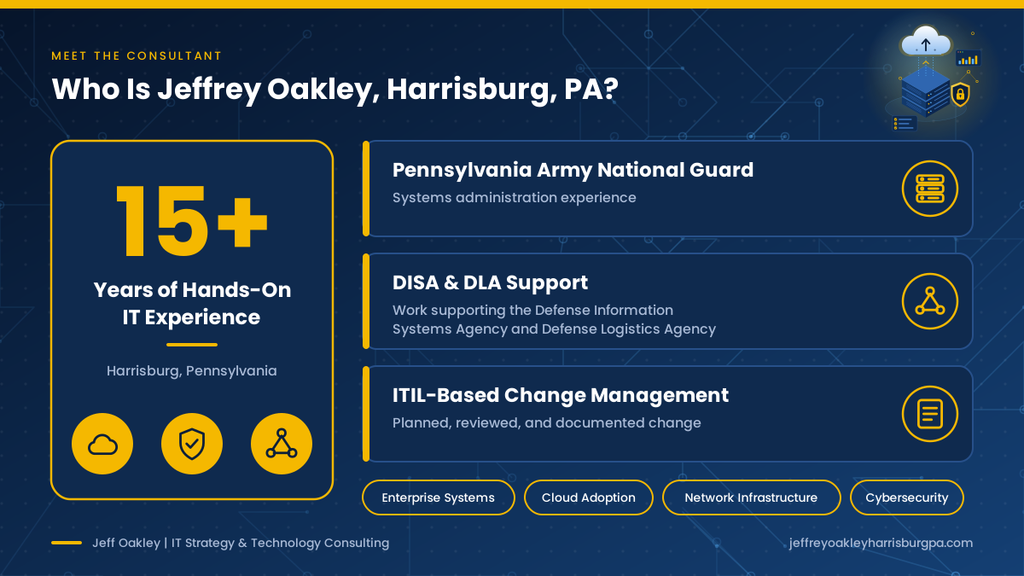
Jeff Oakley is an IT management and technology strategy consultant serving organizations in Harrisburg, Pennsylvania. His experience spans enterprise systems design, cloud adoption, network infrastructure, and cybersecurity.
His background includes systems administration with the Pennsylvania Army National Guard, work supporting the Defense Information Systems Agency, or DISA, and the Defense Logistics Agency, or DLA, and ITIL-based change management. In these environments, uptime, security, and documented process are requirements, not preferences. That discipline carries into his consulting work and shows in his guiding principle: technology should serve the business, not the other way around.
What is IT strategy, and why does it matter?
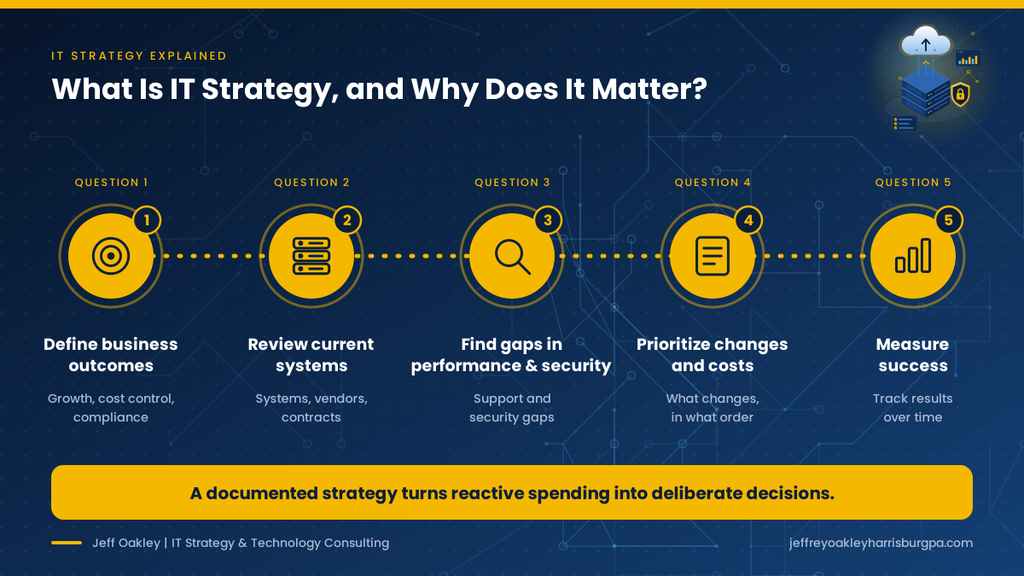
IT strategy is a documented plan that defines how technology will support an organization’s goals over a set period. A useful strategy answers five questions:
1. What business outcomes must technology support, such as growth, cost control, compliance, or customer experience?
2. What systems, vendors, and contracts exist today?
3. Where are the gaps in performance, security, or support?
4. What should change, in what order, and at what cost?
5. How will success be measured?
Without answers to these questions, IT spending tends to become reactive. Organizations replace what breaks instead of improving what matters. A strategy makes spending deliberate and gives leadership a basis for approving or declining projects.
Services at a glance
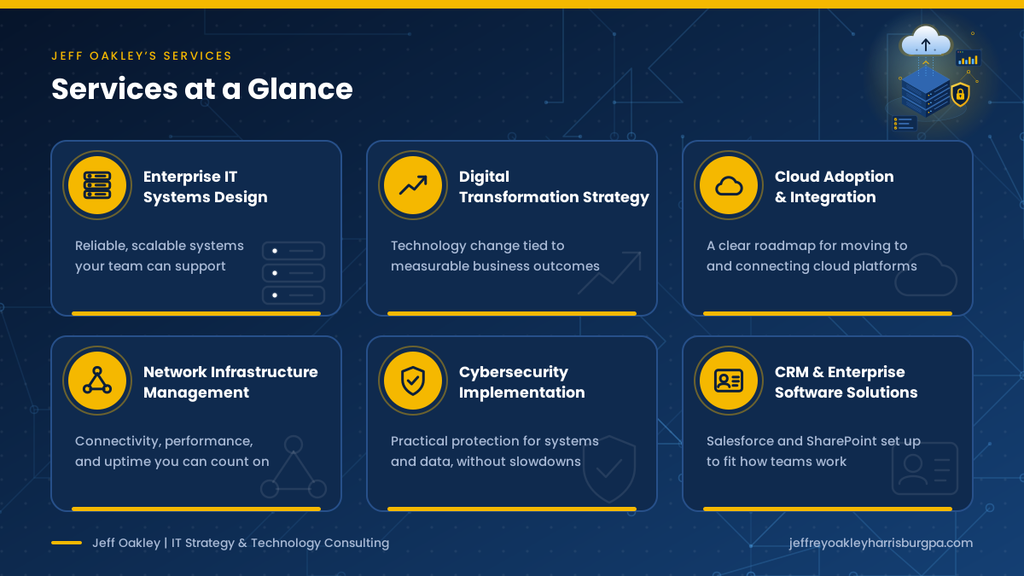
| Service | What it means for your organization |
| Enterprise IT systems design and optimization | Core systems that run reliably, scale with demand, and are easy to support |
| Digital transformation strategy | Technology change tied to measurable business outcomes |
| Cloud adoption and integration | A clear roadmap for moving to and connecting cloud platforms |
| Network infrastructure management | A dependable network foundation for connectivity, performance, and uptime |
| Cybersecurity implementation | Practical protection for systems and data without slowing the business |
| CRM and enterprise software solutions | Platforms like Salesforce and SharePoint configured to fit how teams work |
Jeff Oakley’s six core services, explained
1. Enterprise IT systems design and optimization
Enterprise systems include servers, applications, storage, identity and access management, and the integrations between them. Good design addresses four qualities:
- Reliability: redundancy for critical components and tested recovery procedures.
- Scalability: capacity that grows with users and data without a full rebuild.
- Supportability: standard configurations and documentation so any qualified technician can maintain the environment.
- Cost efficiency: retiring unused licenses and redundant tools.
A common warning sign is dependence on one person who “knows how it all works.” Optimization removes that risk through documentation and standardization.
2. Digital transformation strategy
Digital transformation means changing how work gets done, not just buying software. A practical approach begins by mapping the current process and identifying where time or money is lost. Only then does it select technology that addresses that specific gap.
Typical targets include manual data entry, paper-based approvals, disconnected spreadsheets, and slow reporting. Each project should have a measurable result, such as hours saved, errors reduced, or turnaround time shortened. Jeff ties planning to real business outcomes so that new tools produce visible improvement instead of adding complexity.
3. Cloud adoption and integration
Moving to the cloud is a business decision as much as a technical one. Before migrating, each workload should be assessed and assigned one of several common paths:
- Rehost: move the system as is to cloud infrastructure.
- Replatform: make small changes to take advantage of cloud features.
- Repurchase: replace the system with a cloud-based software service.
- Refactor: redesign the application for the cloud.
- Retire or retain: decommission what is no longer needed, or keep what should stay on-premises.
Skipping this assessment is a frequent cause of cloud bills that exceed expectations. A good roadmap also covers identity integration, data backup, performance monitoring, and ongoing cost review. Jeff builds migrations around a clear plan so the move improves performance and cost control.
4. Network infrastructure management
The network carries every application, call, and file transfer. Sound network management includes:
- Capacity planning: sizing bandwidth for current use and expected growth.
- Segmentation: separating guest, staff, and critical systems so a problem in one area does not spread.
- Monitoring: tracking uptime, latency, and device health to catch problems before users notice.
- Lifecycle management: replacing aging equipment before it fails or loses vendor support.
- Documentation: current network diagrams and configuration records.
Jeff builds and maintains networks with connectivity, performance, and uptime as the priorities.
5. Cybersecurity implementation
Effective security is layered, because no single control is enough on its own. Widely recommended practices include:
- Multi-factor authentication, or MFA, on email, remote access, and administrative accounts.
- Least-privilege access, so users only reach what their role requires.
- Patch management, applying security updates on a consistent schedule.
- Endpoint protection and email filtering to reduce malware and phishing exposure.
- Backups that follow the 3-2-1 rule: three copies of data, on two types of media, with one stored offsite or offline.
- An incident response plan that names who does what when something goes wrong.
Many organizations use the NIST Cybersecurity Framework as a reference. Its current version organizes security work into six functions: Govern, Identify, Protect, Detect, Respond, and Recover. Organizations that handle personal data in Pennsylvania should also be aware of the state’s breach notification law and confirm their obligations with qualified legal counsel. Jeff focuses on practical controls that protect systems and data without slowing the business down.
6. CRM and enterprise software solutions
Business platforms such as Salesforce and SharePoint fail most often because of poor fit, not poor technology. A successful implementation includes:
- Requirements gathering with the people who will use the system daily.
- Clean data migration, since importing messy records only moves the problem.
- Workflow configuration that matches real processes.
- User training and adoption tracking after launch.
Jeff implements and optimizes these platforms so they match how teams actually work.
The three-step process
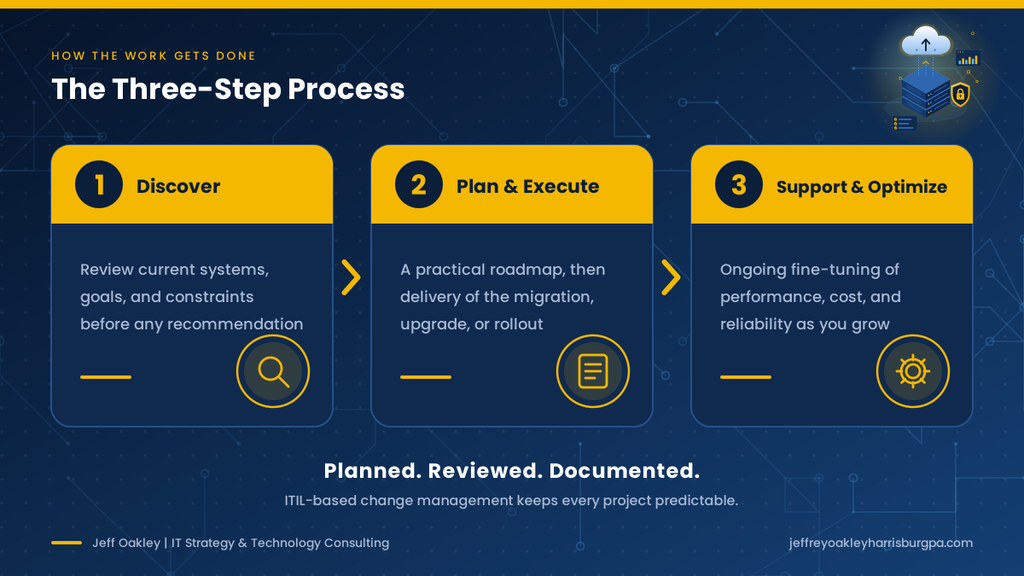
Jeff follows a straightforward process, from first conversation to long-term support.
| Phase | What happens | What you receive |
| 1. Discover | Review of current systems, goals, and constraints before any recommendation | A clear picture of where you stand and what matters most |
| 2. Plan and Execute | A practical roadmap, then implementation of a migration, upgrade, or platform rollout | A prioritized plan and delivered work |
| 3. Support and Optimize | Continued involvement after go-live to tune performance, cost, and reliability | Ongoing improvement as the business grows |
Jeff’s ITIL-based change management background supports this structure. Each change is planned, reviewed, and documented, which reduces the risk of unplanned downtime.
Why local expertise matters in Harrisburg
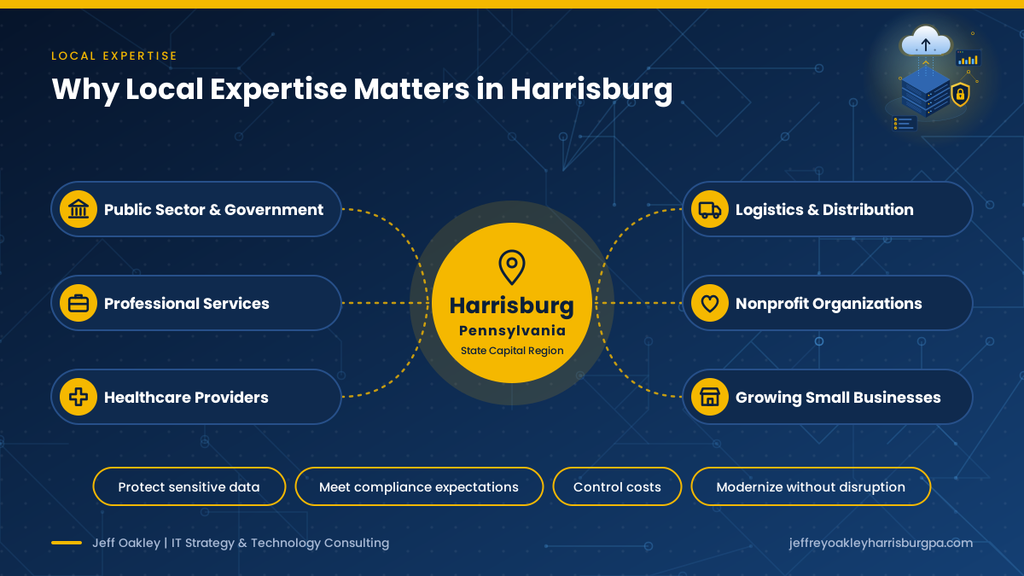
Harrisburg is Pennsylvania’s capital and sits at the center of a regional economy that includes government-related organizations, professional services, healthcare, logistics, nonprofits, and growing small businesses. These organizations often share common needs: protecting sensitive information, meeting compliance expectations, controlling costs, and modernizing systems without interrupting daily operations.
A consultant familiar with disciplined, high-accountability environments is well suited to that market. Jeffrey Oakley, Harrisburg, PA, has experience in secure infrastructure and structured change management, which gives local organizations a dependable resource for planning and carrying out technology improvements.
Signs your organization could benefit from an IT strategy review
- IT costs rise each year without clear improvements in performance.
- Critical knowledge sits with one employee or one outside vendor.
- Staff use workarounds, personal tools, or shared spreadsheets to get work done.
- You cannot easily say which systems hold sensitive data or who can access them.
- A cloud move, software rollout, or network upgrade is planned but has no roadmap.
- Backups exist, but recovery has never been tested.
If several of these apply, a structured review is a sound first step.
Frequently asked questions
What does an IT strategy consultant do?
An IT strategy consultant assesses an organization’s current technology, defines goals, and builds a prioritized plan so technology investments support business outcomes. Many also help carry out the plan.
What services does Jeff Oakley provide?
He provides enterprise IT systems design and optimization, digital transformation strategy, cloud adoption and integration, network infrastructure management, cybersecurity implementation, and CRM and enterprise software solutions, including Salesforce and SharePoint.
What experience does Jeff Oakley have?
Jeff has more than 15 years of hands-on IT experience, including systems administration with the Pennsylvania Army National Guard, support for DISA and DLA, and ITIL-based change management.
How should an organization prepare for a cloud migration?
Start by inventorying applications and data, ranking them by business importance, and choosing a migration path for each. Then plan identity integration, backups, testing, and a cost-monitoring process before moving anything.
What is the first step in improving cybersecurity?
Most organizations see the greatest early benefit from enabling multi-factor authentication, applying updates consistently, and verifying that backups can actually be restored.
How can I contact Jeffrey Oakley, Harrisburg, PA?
Visit the Contact page at www.jeffreyoakleyharrisburgpa.com and schedule a consultation to discuss your IT goals.
Final thoughts
Good technology management is planned, documented, and measured. Jeffrey Oakley, Harrisburg, PA, brings more than 15 years of experience and a people-first approach to helping organizations turn scattered systems into a stable, secure, and scalable foundation for growth.
Ready to review your technology plan? Schedule a consultation with Jeff Oakley.
About the author: Jeffrey Oakley, Harrisburg, PA, is an IT strategy and technology consultant with more than 15 years of experience in enterprise systems, cloud, networking, and cybersecurity.

